M6 — Composition and Structural Patterns
SENG 365 — Software Engineering

2026-07-24
Learning Objectives
Learning Objectives
Reading: Robillard, 3rd ed. — Ch. 6, Composition (pp. 125–156).
- When and how composition makes sense
- Composite, Decorator, and Command design patterns
- Sequence diagrams and the Law of Demeter
Composition vs. “is-a”
- Interfaces and classes use the subtype (“is-a”) relationship. Give an example.
- Composition is the “part-of” relationship (an arm is part of a body).
- Important for assembling large wholes from smaller pieces.
- A
TeamaggregatesPlayers; the team’s points are the sum of player points.
Composite
Composite Pattern
Groups of objects behave like single objects.
Think of folders vs. files: ls doesn’t differentiate, except folders contain children.
- Client code depends on the component type, not concrete implementations.
- Support open-ended configurations via object composition, not class definition.
Composite: Movie Theatre
- Client —
Program - Primitive —
Movie,DoubleBill,Null - Interface —
Show - Composite —
CompositeShow
Name: Composite · Intent: treat groups of objects as a single object.
The Null Object Pattern
- Traversing a Composite, some objects may be empty (a folder with no children).
- Instead of checking for
nulleverywhere, a null object does ano-op. - Removes a class of special-case checks.
Decorator
Design Problem
A point-of-sale system for a coffee shop. Basic beverages, but customers customize (milk, syrup, …).
- A class per drink → combinatorial explosion.
- A single
MultiDrinkwithswitchstatements → a God class with multiple responsibilities.
Decorator Pattern
Name: Decorator · Intent: attach additional responsibilities to an object dynamically.
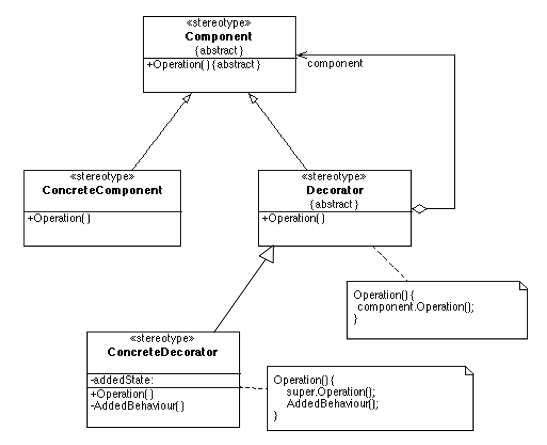
Decorator Explained
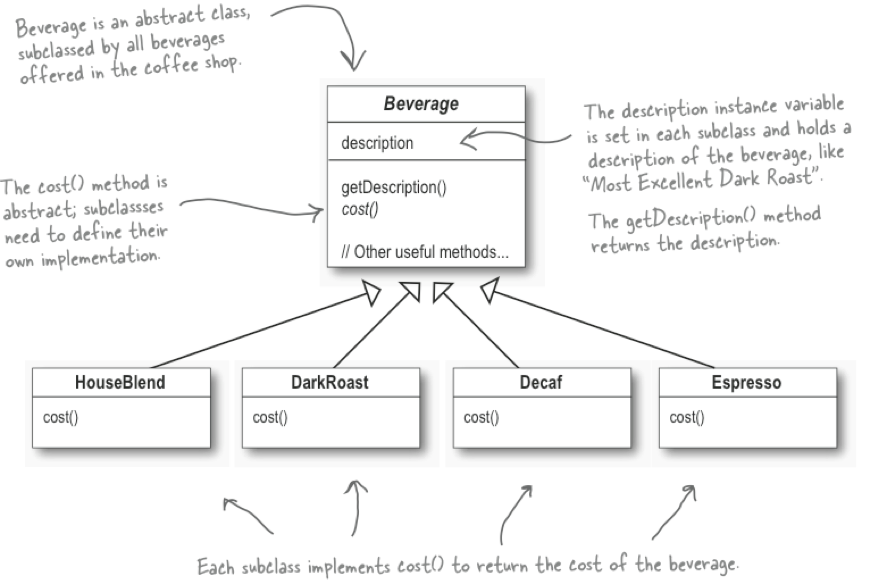
Decorator Concepts
- Decorators are of the primitive type → enables chaining.
- Additive: a decorator cannot remove another’s contribution.
- Implement the primitive type and delegate the method to the decorated object (
cost(),draw()). - Original object identity is lost.
- Common in GUI toolkits.
Copying and Prototype
Object Copying
- Explain with
Show.clone(). - See copying an object in Java.
- Bloch, Effective Java: “Override
clone()judiciously.”
Prototype Pattern
Change the default class at runtime where the type can’t be known ahead of time.
- Create the prototypical class (e.g.
Deck), support dynamic switches (setPrototype). - Downside: the specific type isn’t guaranteed → clients must depend on the interface (good practice anyway).
Command and Demeter
Sequence Diagrams
- Left to students to read up on.
- Focus: how they capture the flow of control.
- Video: example of a REST query and authentication.
Command Pattern
- Commands typically map to method calls (think of a menu item).
- We may want to treat a
Commandholistically — to support undo, GUI mapping, macros. - Make function calls (e.g.
draw()) their own objects. - Design choices: how to access the target; data flow; pre/post conditions; storing command history.
The “Law” of Demeter
- AKA the principle of least knowledge — ensure loose coupling.
aFoundations.getPile(FIRST).getCards().add(pCard);requires too much knowledge of other classes.- Objects should rely only on: the implicit parameter; its fields; method arguments; new objects created within; globally available objects.
- Use only one “dot”; add helper methods (at the expense of clutter).
In-Class Activities
Day 1
- Group discussion
Day 2
- Jackson demo for parsing JSON
- Configuring GitHub Actions
Day 3
- Office hours

Neil Ernst ©️